The Exam Is Won Before It Starts
By the night before an exam, the learning is done — nothing meaningful can still be added, but a great deal can still be protected or squandered. Students lose marks in the final 24 hours to logistics, panic-cramming, wrecked sleep, and morning chaos far more often than to any question on the paper. These exam day tips treat the last day as what it is: a performance to stage-manage, whether the stage is a school hall or a professional test centre for those professional certifications. Cover the night-before routine, the morning checklist, the in-exam tactics that rescue difficult papers, and the short list of things to deliberately not do — and arrive with your preparation intact and available, which is the whole game.
The Night Before: Close the Books, Open the Checklist
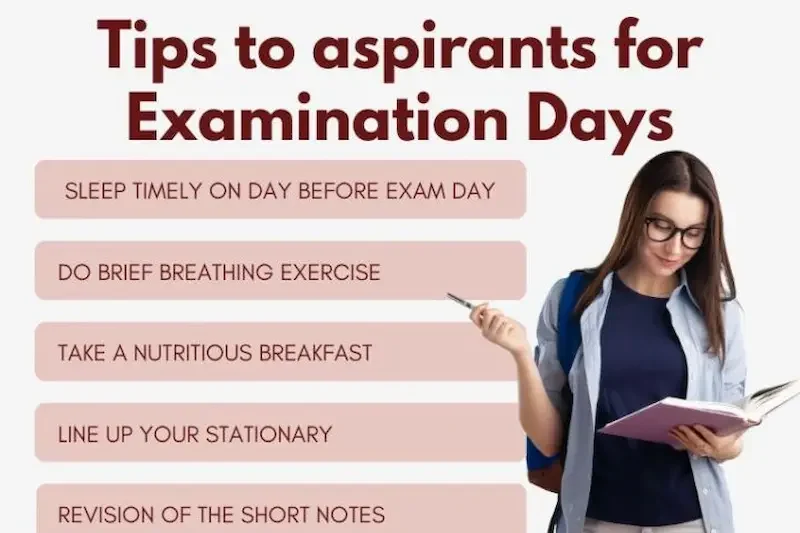
The final evening has two jobs — logistics and physiology — and study is neither of them. Pack and stage everything tonight, not tomorrow: ID and admission documents, permitted materials (calculators with fresh batteries, pens that work — bring spares of everything cheap), water bottle, watch if allowed, and the route planned with its timing, including a buffer for transport behaving badly. Lay out clothes; charge the phone you will then silence. This ritual is not fussiness — it removes every avoidable decision and surprise from the morning, when your nerves are least able to absorb them. Study only lightly, if at all: a calm skim of your summary notes or flashcards is fine; new material, mock exams, and group panic sessions are not — they manufacture the feeling of unpreparedness at the exact moment confidence is the asset. Eat a normal dinner, avoid experiments (tonight is not the night for the energy drink you have never tried), and protect the sleep that consolidates months of learning: screens down an hour early, alarm set once and trusted, bed at the usual time. A student who sleeps beats a student who crammed, on the same preparation, most of the time — the research on memory consolidation is that blunt.
The Morning: Boring on Purpose
Exam morning should be the most routine morning of your year. Wake at the planned time (no heroic early rise — borrowed hours from sleep are repaid in the exam), eat a real breakfast built from foods your body knows, hydrate, and dress in layers for a hall whose temperature nobody controls. Run the staged checklist once, out loud if it helps, and leave with the buffer intact — arriving early and calm is a competitive advantage your rivals hand you by sprinting in breathless. Outside the hall, curate your inputs ruthlessly: the corridor conversation (“did you revise chapter 9?!” “the exam is supposed to be brutal this year”) is anxiety contagion dressed as information, and none of it can change your preparation — headphones, a walk, or your own summary sheet are better companions. If nerves spike, use the physiological lever: slow exhales longer than inhales for a minute or two genuinely down-shift the stress response; it is the same mechanism athletes use on start lines, and it works in exam halls for identical reasons.
Inside the Exam: Pacing, Triage, and the Panic Protocol
The paper itself is a resource-allocation problem, and the first two minutes solve it: read the whole paper, note the mark scheme’s shape, and allocate time by marks, not by question order — then work in the order that banks marks fastest, usually your strongest sections first. Triage without mercy: a question that has consumed twice its time budget gets parked, marked, and abandoned until the end; exams are lost by heroes dying on one question while three easy ones sit unanswered. Write for the marker: state the method, show the steps, answer the question actually asked (reread it before writing — a shocking share of lost marks are correct answers to misread questions), and when stuck, write what you know around the gap, because partial credit is real money left on desks by perfectionists. The panic protocol, for the moment a blank page feels like a verdict: pen down, slow breathing for thirty seconds, then restart on the easiest remaining question and rebuild momentum from a success. Everyone’s brain stalls at least once; the protocol converts a stall from a spiral into a pause. Reserve the final ten minutes exclusively for review — arithmetic slips, unanswered sub-parts, the question you parked — because review time has the highest marks-per-minute of the entire exam.
What Not to Do: The Short List That Saves Marks
Do not learn anything new in the final 24 hours and expect it to be usable — unconsolidated facts crowd out consolidated ones under stress. Do not compare answers in the corridor afterwards if another exam follows; the post-mortem only ever surfaces the questions you got wrong and imports dread into the next paper. Do not change your entire strategy mid-exam (“I will write more, faster, differently”) — the plan you rehearsed is the plan your preparation supports. Do not skip the boring basics under adrenaline: name and ID on the paper, instructions reread, every page attempted. And do not treat one bad exam as a verdict on the subject or on you: mark schemes forgive, resits exist, and the student who debriefs calmly — what worked, what to stage-manage better next time — converts even a poor paper into preparation for the next one. The performance mindset is the tip underneath all the others: the exam is a demonstration of work already done, and your only remaining job is not to get in its way.
The Bottom Line
Exam day tips, as a system: stage everything the night before, sleep like it is part of the syllabus, make the morning boring, curate the corridor, pace by marks with ruthless triage, keep a panic protocol in your pocket, and defend the final ten minutes for review. Months of preparation deserve a last day that protects them — and that day is entirely, reassuringly, within your control.